
The Annual Meat Conference, held in March each year, draws thousands of processors, retailers, consultants, and others from across the nation. The Big Four packers, executives from Walmart, Kroger, and other major retailers, are well represented at the conference. But the audience also includes a host of smaller processors, distributors, and retailers.

They come for networking, glimpses into new products, and information on the commodity outlook for beef, pork, and poultry. But mostly, they come for the unveiling of the latest Power of Meat Report.
This year didn’t disappoint.
For the past two decades, the annual Power of Meat report, funded by the Food Marketing Institute and the American Meat Institute, has provided the deepest dive into consumer behavior in the retail meat and poultry marketplace.
This year's conference attendees were eager to gain insights into the surprising dichotomy of rising meat prices and rising consumer demand.
As noted in the introduction of this year’s report, “The 2026 edition captures how consumers navigated ongoing financial pressure in 2025, reinforcing meat’s role as a dietary and budget priority while revealing how value, health, convenience, and sustainability continued to reshape shopping and eating behaviors.”
The report’s author, Anne-Marie Roerink, president at 210 Analytics, reviewed the report’s findings during the opening general session in a presentation peppered with snippets from consumer interviews across the country.
Smaller processors can find plenty to smile about in this year’s report.
First, a demographic sea change is occurring in the overall marketplace.
The Baby Boomer generation is slowly becoming a less significant market driver, and the oldest members of Generation X are now approaching retirement. Meanwhile, Millennials and Gen Z shoppers are the new 900-lb. gorilla in the meat marketplace.
The good news is that these shoppers are embracing animal protein. The even better news is that they are embracing the types of animal protein that smaller ranchers and processors bring to the marketplace.
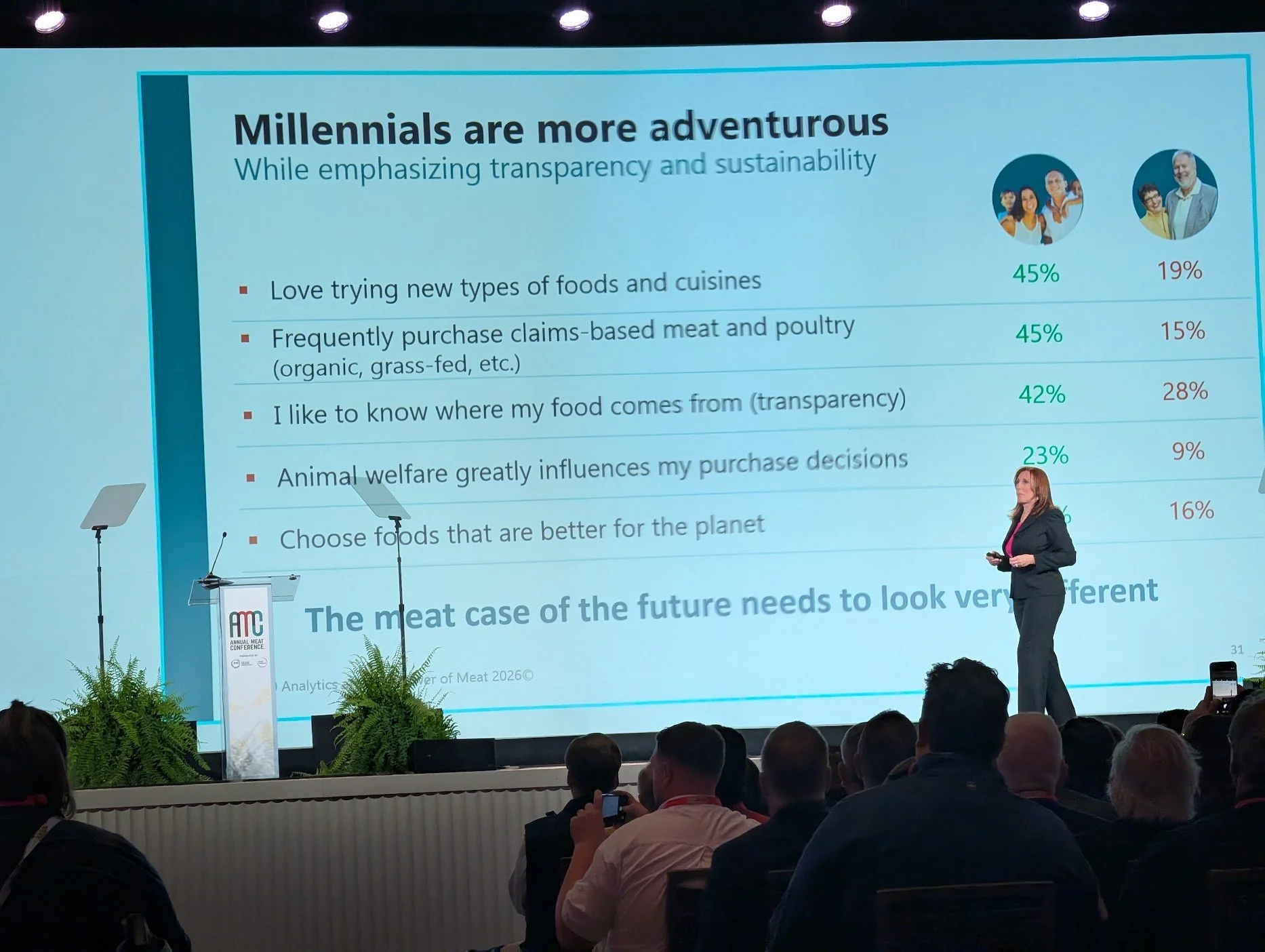
The report notes that shoppers associate meat with strength, energy, and overall wellness, creating opportunities to reinforce meat’s role in balanced diets and educating consumers on nutrient density and protein quality.
Younger shoppers are demanding more transparency in the products they purchase.
Power of Meat notes that consumer engagement with claims-based meat and poultry reached a new high in 2026, as reflected in both household penetration and purchase frequency. The share of consumers who buy these products frequently or whenever possible has doubled since 2015, rising from 18% to 36%.
“How animals are raised is important to two out of three shoppers today,” Roerink told the conference.
Grass-fed and raised in the U.S. are both significant considerations among younger shoppers as well.
Several presentations noted the emerging K-shaped economy, with divergent shopping behavior among well-off consumers and those struggling to make ends meet. Roerink said, “Financial strain often leads to where and how animals are raised and handled being a lower priority. In contrast, financially comfortable and secure consumers over-index across nearly all attributes.”
Still, humane, free-range, pasture-raised, and organic production practices are purchase priorities for around 30% of shoppers. Those issues rank even higher in the purchasing decisions of younger shoppers.
Roerink and other speakers stressed that demographic information is simply a benchmark, and that individual shopping behavior varies significantly within each segment.
James Mowcomer, a corporate chef addressing the gathering, noted that processors and marketers need to know their audience.
“Introducing new trends without knowing your customers is just trend hopping,” he said. “You have to know what is important to your customers.”
More information on the latest Power of Meat report will be provided in the next Flower Hill Institute Quarterly Marketplace update, scheduled for posting next month.
